There is a bone in your body that does not know it is supposed to stop. Every other long bone in the adult human skeleton has closed its growth plates by the time you can legally rent a car. The femur is done. The tibia is done. The humerus and radius and ulna are done. Even the hand bones, the small industrious architecture of the fingers, have settled into their final geometry. They are, in the technical language of orthopedics, skeletally mature. Nothing is going to change about them without breaking them first.
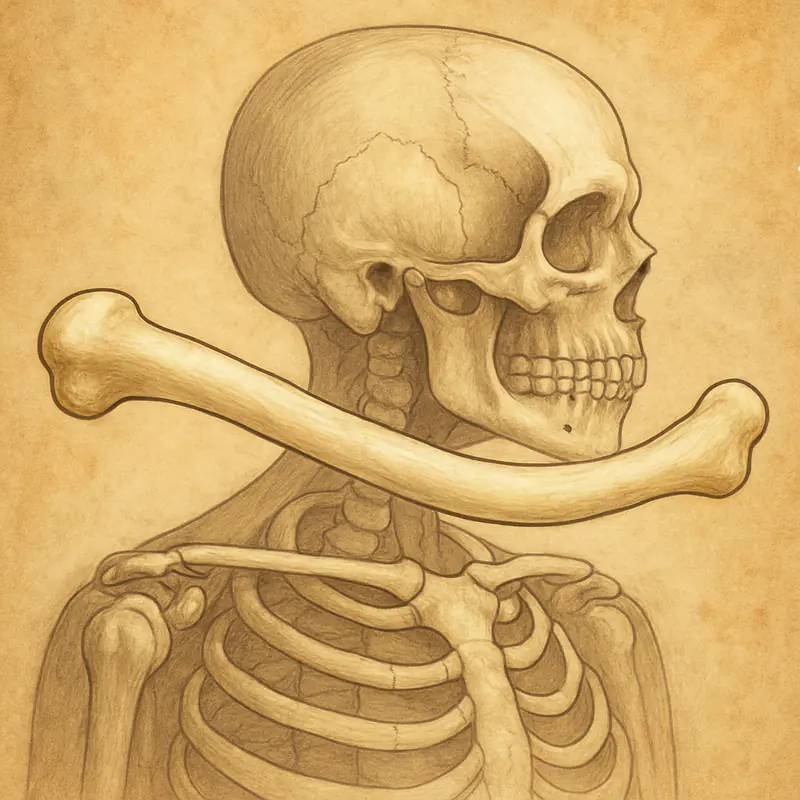
The clavicle is different. The medial end of the clavicle — the inner end, the one that meets the sternum just below the notch at the base of your throat — keeps a little door open. Its growth plate, the physis that drives elongation at any endochondral bone, is still there when you turn twenty, still there when you turn twenty-three, and for some people still faintly open when you turn twenty-seven. It is the last bone in the body to close the door on its own childhood. That single biological fact is the reason the clavicle has become, quietly, the subject of one of the stranger research conversations in contemporary musculoskeletal science.
The Last Open Room
I find this fact beautiful in a way that is hard to justify in strictly clinical terms. The body, for all its relentless drive toward completion, maintains a single room in which the machinery of adolescence continues to operate into adult life. The medial clavicular physis is that room. Chondrocytes — the cartilage-producing cells that, at every other growth plate in the body, went quiet years earlier — are still in there doing their work. They are still dividing, still laying down cartilage matrix, still responding to the growth factor signaling that governs bone elongation in a way that the rest of the adult skeleton no longer does.
The embryologists have an explanation for this, and the explanation is itself poetic. The clavicle is an embryological hybrid. It begins forming around the fifth week of gestation, earlier than any other bone, through a process called intramembranous ossification — the direct conversion of connective tissue into bone, the same mechanism that builds the skull. It is, in its origin, a flat bone pretending to be a long one. Only later does it acquire the endochondral growth plates at its ends that give the long bones their proper lengthening mechanism. The secondary ossification center at the medial end is the last of its kind to appear in the entire body, and it is the last of its kind to go away. The clavicle is a bone that started late and finishes late and keeps a little of its youth later than it has any right to.
What the Numbers Actually Say
Any good essay on the body eventually has to put down the metaphors and pick up the measurements, because the body is precise and deserves precise attention. Here are the measurements.
Longitudinal studies of clavicular length in healthy adolescents and young adults — the most cited is a series published in 2020 by Hughes and colleagues — show that between age 12 and age 25, male clavicular length increases by approximately 34 percent, which works out to roughly 45 millimeters of new bone. Female clavicles grow about 26 percent over the same window, roughly 33 millimeters. The growth is not front-loaded to the early teen years in the way that general linear height is. A meaningful fraction of total clavicular elongation in both sexes happens after the age at which you stopped getting taller.
Fusion studies using CT imaging and the Schmeling-Kellinghaus five-stage classification system place complete closure of the medial clavicular physis somewhere between ages 23 and 27 in most individuals, with a tail that extends toward 30 in some cases. Women fuse earlier than men. Individual variation is enormous — wide enough that chronological age alone is not a reliable guide to where a particular person sits in the closing sequence.
The numbers are specific, which is part of what makes them beautiful. The biology is telling you exactly how long the room stays open.
Why Chemistry Walked Into the Room
If the medial clavicle is the last open physis in the adult skeleton, and if the biology of physeal function is the biology of growth factor signaling at proliferating chondrocytes — which it is, and has been understood to be for several decades — then the question of whether compounds that modulate growth factor signaling can influence what happens at that site becomes a legitimate research question. Not an obvious one. Not a well-answered one. But a legitimate one.
The compounds most often discussed in this context fall into a few categories. Growth hormone secretagogues — CJC-1295 and ipamorelin are the most commonly named — act upstream of the system by amplifying the body's own pulsatile growth hormone release without introducing exogenous hormone directly. IGF-1 analogs, particularly a modified form called IGF-1 LR3, extend the active half-life of IGF-1 signaling from minutes to roughly a day, producing sustained receptor activation at every site where IGF-1 acts, including chondrocytes at an open physis. Connective tissue peptides like BPC-157 and TB-500 don't act on the physis directly, but they support the training ceiling that mechanical loading protocols require.
None of this is a magic wand. The human evidence for the specific outcome — measurable clavicular elongation in an adult running a peptide protocol — is thin. The mechanistic case is sound. The clinical confirmation is pending. The honest framing is that this is an open research question with a coherent biological rationale, and the people taking it seriously are mostly taking it seriously in exactly that spirit.
For readers who want a more technical breakdown of the compound categories and the research rationale behind them, the reference compilation at Clavicular Stack is the most systematic public overview of the topic I've come across. It is not promotional literature — it is closer to a field guide, written for readers who want the mechanism before they want anything else.
Mechanical Loading, or Why the Body Needs to Be Asked
The part of this conversation that gets skipped the most often, and should be skipped the least, is mechanical loading. Bones respond to the forces imposed on them. Growth factor signaling creates the potential for adaptation; mechanical load provides the signal that tells the bone where to adapt. A protocol that stacks the hormonal environment without loading the target structure is running only half of the intervention, and the half it is running is the half that is least likely to produce a localized outcome.
For the clavicle, the loading movements that transmit direct force through the bone are compound overhead pressing and heavy horizontal pulling. Both translate force through the acromioclavicular and sternoclavicular joints — the two ends of the clavicle — and into the shaft. The loading has to be heavy enough, frequent enough, and sustained over long enough a window to actually drive adaptation. Weekly fluctuations are noise. Multi-month progressive overload is signal.
There is something fitting about this. The bone that refuses to settle responds to being asked to carry weight. The last open growth plate is the one that still wants to be used.
Imaging First, Always
If any of this is to be taken seriously as a research protocol rather than a vague hope, the first step is imaging. A single baseline CT scan can stage the current ossification status of the medial clavicular physis using the Schmeling-Kellinghaus classification, and the result of that single image is the most useful piece of information a person pursuing this line of investigation can have. Stage 1 or stage 2 means the physis is effectively open and the biological substrate for intervention is present. Stage 4 or stage 5 means the door has already closed and the protocol should shift to an entirely different mechanism — periosteal apposition, which is a lifetime-available process but a different kind of adaptation with a different set of expectations.
Chronological age is not a substitute for imaging. The variation is too wide.
A Note on the Question Underneath the Question
The clavicle matters to people in this research conversation because the clavicle matters to the shape of a person. Biacromial width — the straight-line distance between the outer points of the shoulders — is substantially determined by clavicular length, and biacromial width is one of the strongest determinants of how the whole body reads visually. A wider clavicle makes the same waist look narrower, the same head look smaller, the same muscular development look more impressive. It is a quiet, structural variable that exerts an outsized effect on presence.
I don't think there is anything shallow about caring about this. Bodies are how we meet each other. The architecture of the body is part of what a life is made of. That a small number of researchers have taken the last open growth plate in the human skeleton seriously enough to ask whether it can be coaxed into doing a little more of what it was already doing seems, to me, like an entirely reasonable thing to care about — and a reasonable thing to write a careful essay about.
The Quiet Door
The clavicle is still open. For a few years, at the medial end, the room where the cells of childhood were still dividing remains there, doing its quiet work, until eventually the door closes and the bone becomes part of the finished architecture. What people have started asking — carefully, imperfectly, often ahead of the clinical evidence but not ahead of the underlying biology — is whether that last open room can be made to do a little more before it closes. The question is not finished. The evidence is not complete. The mechanism is real.
It is, in the end, a small and specific thing. One bone. One physis. One biological window that lasts a few years and then doesn't. But the body is full of small specific things, and sometimes the small specific things are the ones that hold the shape of you.