BPC-157 for Skin Healing and Facial Aesthetics: What the Research Actually Shows
BPC-157 is a 15-amino-acid peptide with one of the most documented healing profiles in peptide research. This article examines its dual angiogenic pathways, anti-inflammatory cytokine modulation, collagen remodeling effects, and gut-skin axis implications.
BPC-157 is a 15-amino acid peptide derived from human gastric juice with one of the most documented healing profiles in peptide research. This article examines its dual angiogenic pathways, anti-inflammatory cytokine modulation, collagen remodeling effects, and gut-skin axis implications — and what that means for those seeking faster recovery and improved skin quality.
What Is BPC-157 and Why Is It Getting So Much Attention?
Body Protection Compound-157 — BPC-157 — is a synthetic pentadecapeptide consisting of 15 amino acids, derived from a protective protein naturally found in human gastric juice. It was first characterized through Croatian research in the 1990s and has since accumulated one of the broadest cross-tissue healing profiles of any peptide currently studied in the research community.
For those approaching appearance optimization through evidence-based methods, BPC-157 sits in an interesting position: it isn’t primarily a cosmetic compound, yet its mechanisms of action touch nearly every biological process relevant to skin quality, recovery efficiency, and post-procedure healing. Understanding the science behind it reveals why it’s become a fixture in serious recovery protocols worldwide.
It’s important to note upfront that BPC-157 has not been approved by the FDA for human therapeutic use. The majority of research comes from animal models, with only three published human pilot studies as of 2025. This article examines the mechanistic evidence and what it suggests — not as medical advice, but as a guide to understanding the science.
The Dual Angiogenic Pathway: Why BPC-157 Heals So Many Different Tissues
Most healing compounds work through a single mechanism. BPC-157’s unusual breadth — documented effects in skin, tendons, ligaments, muscle, gut mucosa, cornea, and more — likely traces back to one distinctive biological feature: it activates angiogenesis (the formation of new blood vessels) through two independent pathways simultaneously.
The first is the VEGFR2-dependent route. BPC-157 activates Vascular Endothelial Growth Factor Receptor 2, triggering a PI3K → Akt → eNOS cascade that results in nitric oxide production and endothelial cell proliferation. The second pathway — VEGFR2-independent — operates through Src → Caveolin-1 → eNOS, bypassing VEGF requirements entirely. This redundancy means that if one pathway is disrupted, the peptide can still drive vessel formation through the other.
The practical implication: BPC-157 doesn’t just heal what it’s injected near. It generates new capillary networks throughout affected tissue, improving oxygen and nutrient delivery at a fundamental level. For skin — which is entirely dependent on dermal microvasculature for repair capacity — this explains why researchers report improved wound closure speeds and reduced scarring in animal models.
Collagen Remodeling: Not Just More Collagen, Better Collagen
One of the most common mistakes in discussing peptides for skin is equating all collagen-stimulating effects equally. BPC-157’s collagen impact is specifically notable because it doesn’t simply increase deposition — it improves organization and maturity of the resulting collagen matrix.
Through FAK (Focal Adhesion Kinase) and paxillin signaling, BPC-157 drives fibroblast migration into damaged areas. Studies show dose-dependent increases in fibroblast transwell migration that are time-correlated with improved healing outcomes. The resulting collagen tends to show better structural alignment and tensile strength compared to control tissue, with histological analysis demonstrating more mature collagen fibers and reduced hypertrophic scarring patterns.
For aesthetic applications, this distinction matters considerably. Scar tissue formed with BPC-157 supplementation in animal models tends to be flatter, softer, and more structurally similar to native skin — a meaningful difference for anyone seeking to recover from microneedling, resurfacing procedures, or dermal injuries without visible marks.
BPC-157 also fine-tunes the MMP-1/TIMP-1 ratio — balancing matrix metalloproteinase activity (which breaks down damaged collagen) with tissue inhibitor activity (which prevents over-degradation). This balance prevents both excessive fibrosis and inadequate remodeling, guiding tissue toward genuine renewal rather than rough patch-up repair.
Anti-Inflammatory Selectivity: A Different Approach to Skin Inflammation
Chronic low-grade inflammation is one of the primary accelerants of both dermal aging and persistent skin conditions like acne, rosacea, and eczema. Standard anti-inflammatory interventions — NSAIDs, topical steroids — suppress inflammation broadly, often impairing the early-phase inflammatory signals the body uses to initiate healing.
BPC-157 operates differently. Research documents significant reductions in TNF-alpha, IL-6, IL-1β, and interferon-gamma — the main pro-inflammatory cytokines driving skin aging and inflammatory conditions. Simultaneously, BPC-157 appears to preserve constructive inflammatory signaling necessary for the repair initiation phase. It also decreases COX-2 expression and myeloperoxidase activity, both associated with tissue-damaging oxidative inflammation.
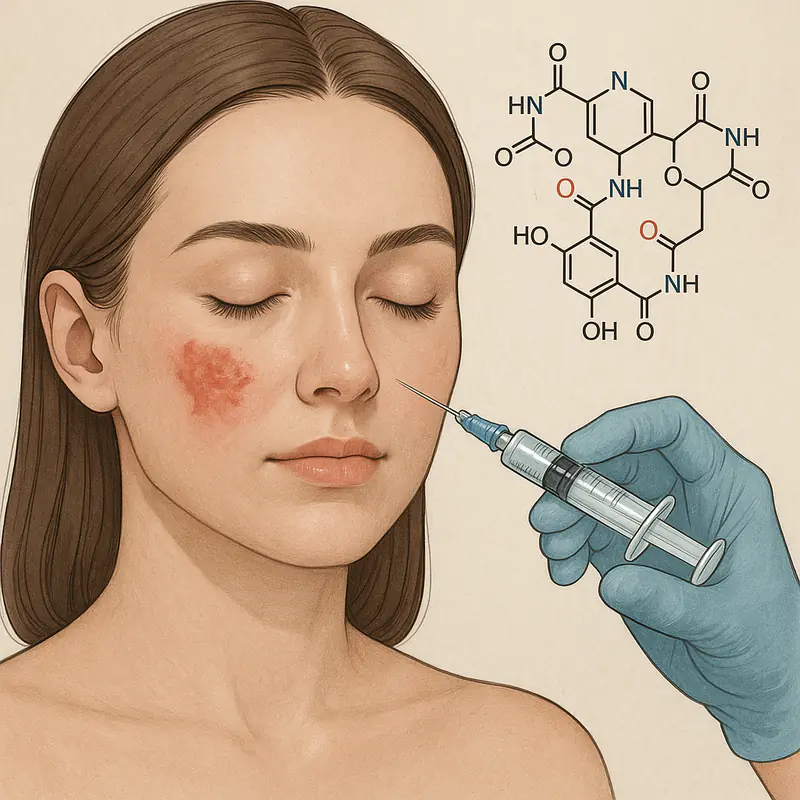
For rosacea specifically, research has documented that BPC-157 reduces KLK5 enzyme concentration across the epidermis — concentrating it only in upper skin layers where it causes less visible damage, rather than spreading throughout the dermis as it does in untreated rosacea-affected skin. This is a specific and notable finding for a condition that directly impacts facial appearance.
The Gut-Skin Axis: The Mechanism Most People Overlook
Emerging research on the gut-skin axis has made clear that gastrointestinal health and skin quality are bidirectionally connected through systemic inflammation, microbiome signaling, and nutrient absorption. Compromised intestinal barrier function — “leaky gut” in common parlance — allows bacterial endotoxins into circulation, driving systemic inflammation that manifests partly through skin.
BPC-157’s original research context was gastric protection. It directly promotes healing of intestinal epithelium, enhances mucosal barrier integrity, and improves the gut microbiome environment through greater GI-immune-nervous system communication. Its role in the brain-gut axis has been studied in the context of stress disorders and CNS disturbances — relevant because chronic psychological stress is a documented trigger for inflammatory skin flares.
For those whose skin issues have a gut-inflammation component — which may account for a significant portion of persistent acne and rosacea cases — BPC-157’s GI-protective properties represent a potentially meaningful pathway to skin improvement that topical interventions alone cannot address. This systemic angle is one reason researchers exploring comprehensive appearance optimization protocols often include BPC-157 alongside targeted skin peptides like GHK-Cu.
Those actively sourcing compounds for research protocols often reference community aggregators when evaluating vendor options; Peptidesgetonline is one resource used in the research community for comparing compound availability and purity documentation across suppliers.
Post-Procedure Recovery Applications
One of the most practical applications for appearance-focused researchers is BPC-157’s potential role in accelerating recovery from aesthetic procedures. Microneedling, fractional laser, chemical peels, and dermabrasion all work by inducing controlled tissue damage and relying on the body’s repair response for results. The quality of that repair determines outcomes.
In wound healing models, BPC-157 consistently demonstrates faster re-epithelialization, improved granulation tissue quality, and reduced visible scarring compared to untreated controls. The same mechanisms that drive this — enhanced angiogenesis, balanced MMP activity, selective anti-inflammation, organized collagen deposition — directly support the biological processes that convert post-procedure damage into improved skin texture rather than scarring.
Corneal healing research adds another dimension: BPC-157 has been shown to accelerate corneal epithelial defect closure within 72–96 hours in animal models, while preventing unwanted neovascularization during healing — exactly the precision needed for ocular aesthetic procedures like blepharoplasty recovery.
Oxidative Stress Defense: The Multi-Layered Mechanism
Oxidative stress — the accumulation of reactive oxygen species that damage cellular structures — is a primary driver of skin aging. UV exposure, environmental pollution, metabolic activity, and chronic inflammation all generate ROS that degrade collagen, damage lipid membranes, and impair cellular DNA.
BPC-157 provides both direct and indirect antioxidant protection. Directly, its four carboxylic groups can be reactivated by glutathione or enzymes to scavenge free radicals at molecular positions inaccessible to conventional antioxidants. Indirectly, it upregulates multiple antioxidant enzyme systems: Heme Oxygenase-1 (limiting inflammatory damage), Heat Shock Proteins 70 and 90 (mitigating oxidative stress effects), and glutathione reductase, glutathione peroxidase 2, and NQO-1 — working in synergy to neutralize ROS across compartments.
This layered defense aligns well with the broader peptide approach to skin health documented at resources like Peptides Looksmaxxing, where the combination of antioxidant peptides, collagen stimulators, and repair compounds is increasingly treated as a comprehensive system rather than isolated interventions.
Dosing Protocols in Research Literature
Human pilot data on BPC-157 dosing is sparse. The most cited clinical trial used 200 mcg per person per day (approximately 3.33 mcg/kg) delivered intramuscularly for 7 days. A 2025 intravenous pilot study in two healthy adults tolerated doses up to 20 mg without adverse events. Retrospective intra-articular case series used approximately 2 cc of 2,000 mcg/mL solution with sustained symptom improvement reported in 7 of 12 patients at 6-month follow-up.
Community research protocols commonly report 250–500 mcg once daily subcutaneously, with local injection near the target tissue for musculoskeletal applications and systemic injection for skin, gut, or general healing applications. A 2022 study in the World Journal of Gastroenterology suggested oral administration may be preferable for localized GI tract protection, though bioavailability versus injectable routes remains poorly characterized.
Pharmacokinetically, BPC-157 has a half-life under 30 minutes and is detectable in urine by mass spectrometry for up to 4 days, suggesting metabolic pathways that distribute it broadly before clearance.
Research Limitations and Responsible Use
Intellectual honesty demands acknowledging what BPC-157 research does not yet establish for humans. As of 2025, only three human pilot studies have been published. No randomized controlled trials in human subjects exist. The gap between the compelling animal model data and confirmed human efficacy is real and substantial.
Long-term safety data in humans is absent. Regulatory status in most jurisdictions classifies BPC-157 as a research chemical, not an approved therapeutic. Anyone approaching it as anything other than a research compound — with appropriate medical supervision, baseline bloodwork, and realistic uncertainty about human extrapolation — is operating outside the evidence base.
For those conducting research, compound purity is paramount. Peptide synthesis quality varies dramatically across suppliers, and contaminated or underdosed research compounds produce neither valid data nor reliable outcomes. Detailed comparison of compound specs and third-party testing documentation is available at Clavtides, a reference used by researchers building peptide protocols.
Conclusion: BPC-157 as a Foundation of Evidence-Based Healing Optimization
BPC-157’s unusual tissue versatility, dual angiogenic pathways, selective anti-inflammatory action, and organized collagen remodeling effects make it one of the most mechanistically compelling compounds in the peptide research space. Its gut-skin axis applications offer a systemic dimension that purely cosmetic peptides cannot address.
The evidence base is predominantly preclinical — this cannot be overstated. But the specificity and consistency of findings across multiple tissue types and experimental models makes BPC-157 a research priority whose human clinical data will be worth watching closely.