Why a Freeze Dried Cake Collapses
Collapse temperature is the point where a drying cake stops holding its own pore structure and slumps. It sits one to three degrees above the glass transition, and that narrow margin decides how fast a freeze drying cycle can run.
- What a Freeze Dried Cake Is
- What Collapse Temperature Measures
- Why Collapse Sits Above the Glass Transition
- How Freeze Dry Microscopy Finds the Point
- What the Sugar in the Formula Does
- Why Mannitol Behaves Unlike Sucrose
- What Annealing Changes in the Frozen Layer
- What a Collapsed Cake Actually Costs
- What Collapse Looks Like in a Finished Vial
- Why Drying Warmer Is Worth the Risk
What a Freeze Dried Cake Is
A freeze dried cake is the solid porous plug left in a vial after water has been removed from a frozen solution by sublimation rather than evaporation. The structure is not incidental. Ice crystals grown during freezing occupy space, and when they sublime away under vacuum they leave the pore network behind as a negative impression of themselves.
What remains once the water is gone can be a substantial fraction of the vial. Formulations characterised in this literature include an IgG1 antibody at 150 mg per millilitre with 10 percent sucrose, and lysozyme at 100 mg per millilitre with 10 percent trehalose.
That network is why the cake matters. Vapour escaping from deeper layers has to travel out through those pores, so their size and continuity set how fast the batch can dry. A cake with open, well-connected pores offers low resistance to mass transfer. One whose pores have closed offers a great deal more, and the drying front slows behind it.
Everything that follows is about a single question: at what temperature does that structure stop holding itself up.
What Collapse Temperature Measures
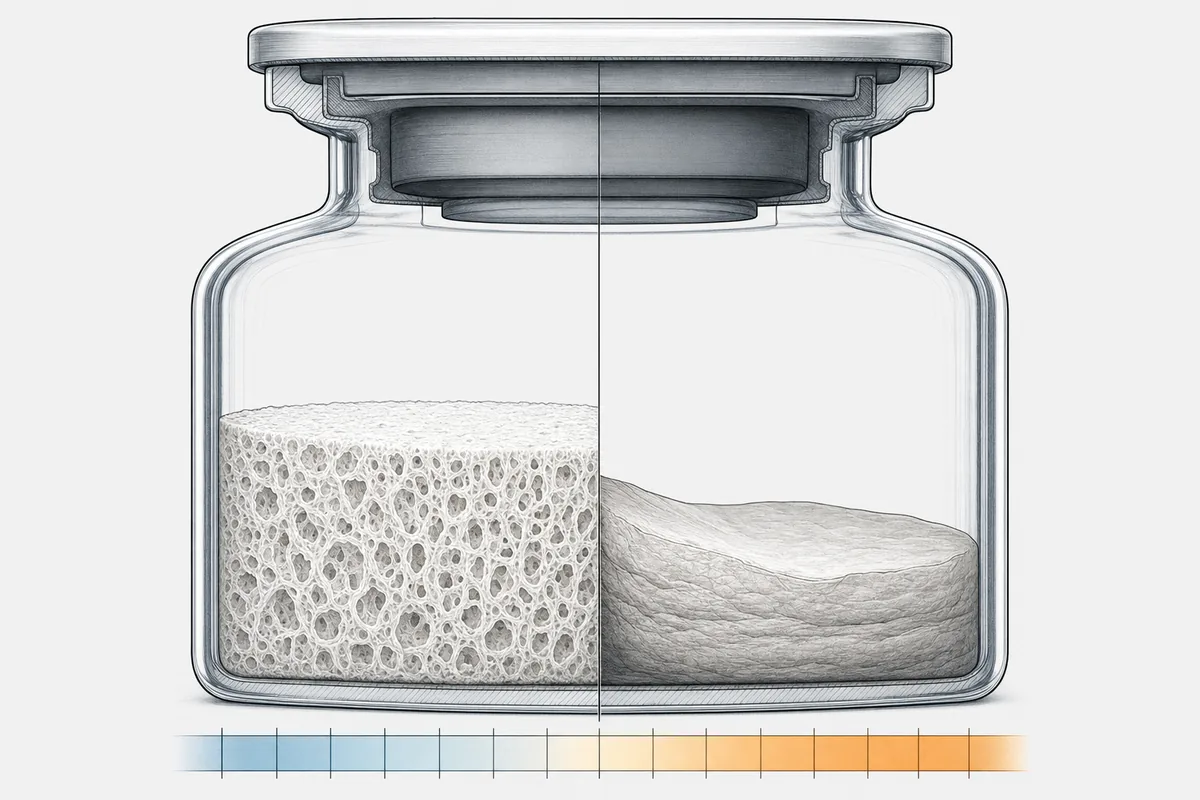
Collapse temperature, written Tc, is the product temperature above which the drying cake loses its pore structure and slumps into a dense mass. Below it the frozen concentrate behaves as a rigid glass and holds its shape as ice leaves. Above it the same material becomes rubbery and viscous enough to flow, and the walls between pores sag into the voids they were separating.
Measured collapse temperatures sit a little above the point where the concentrate first softens, typically by 1 to 3 degrees Celsius. The gap is narrow, and it is the whole operating margin.
The distinction worth holding onto is that collapse is a mechanical failure, not a chemical one. Nothing is necessarily destroyed at the molecular level the moment a cake slumps. What is lost is the geometry, and the geometry is what the rest of the process depends on.
Collapse is also not all-or-nothing. Microcollapse affects pore walls locally while the cake still looks intact; macrocollapse is visible slumping, shrinkage away from the glass, or a glazed surface where a matte one was expected.
Why Collapse Sits Above the Glass Transition
The glass transition temperature of the maximally freeze-concentrated solution, Tg prime, marks where the frozen concentrate softens from a glass into a rubber. Collapse temperature sits close by but slightly higher: measured Tc values typically run 1 to 3 degrees Celsius above the corresponding Tg prime.
The gap exists because softening and flowing are not the same event. At Tg prime the concentrate gains molecular mobility, but viscosity remains high enough that pore walls hold their shape over the timescale of drying. Only a degree or two further up does viscosity fall far enough for gravity and surface tension to pull the structure down within the hours a drying cycle actually takes.
That narrow margin is why the two numbers are measured separately rather than one being inferred from the other. Two to three degrees is a meaningful amount of process headroom when a cycle runs for days.
How Freeze Dry Microscopy Finds the Point
Freeze dry microscopy determines collapse temperature by watching a thin frozen film dry under vacuum on a temperature-controlled stage while an operator observes the drying front through a microscope. The temperature is raised in steps and the moment structure begins to fail behind the front is recorded as Tc.
Glass transition is measured differently, by differential scanning calorimetry, which detects the heat-capacity step as the concentrate softens rather than observing any physical change. The two techniques answer different questions, which is why a formulation record usually carries both.
Optical fibre systems have since been used to detect the same events inside real vials rather than on a microscope slide. In one study a structural change appeared as pore sizes began increasing from around minus 18 degrees Celsius, marking the onset of collapse for a protein formulation.
What the Sugar in the Formula Does
The sugar in a lyophilised formulation sets the thermal ceiling for the whole cycle, because it dominates the glass transition of the freeze-concentrate. Its choice is therefore a process decision as much as a stabilisation one, and the measured values differ enough to matter.
Concentration shifts these only slightly. Sucrose measured minus 33.7 degrees at 5 percent and minus 33.1 at 20 percent, a spread of barely half a degree across a fourfold concentration change. Trehalose showed the same pattern between minus 30.5 and minus 29.4 degrees.
Trehalose therefore buys roughly three degrees of headroom over sucrose, which is why it appears in formulations where cycle time is under pressure. Stachyose sits higher still at minus 23.8 degrees for a 20 percent solution, though its use is far narrower.
Proteins raise the ceiling too. In formulations containing them, collapse temperature rises relative to the glass transition rather than tracking it.
Why Mannitol Behaves Unlike Sucrose
Mannitol differs from the disaccharides because it crystallises rather than remaining amorphous, and a crystalline matrix does not collapse in the way a glassy one does. That makes it useful as a bulking agent where a firm, elegant cake is wanted, and unpredictable where it is not.
A 10 percent mannitol solution showed two distinct glass transition events, at minus 29.5 and minus 24.1 degrees Celsius, rather than the single value a simple amorphous system gives. Crystallisation events were recorded separately, with a broad peak beginning near minus 30 degrees during freezing and a secondary event at minus 22.6 degrees on thawing.
The practical consequence is that mannitol only protects the cake if it has actually crystallised. Mannitol trapped in the amorphous state contributes to the glassy phase instead, lowering the effective ceiling rather than raising it, and it can crystallise later during storage.
What Annealing Changes in the Frozen Layer
Annealing is a deliberate hold at a temperature above the glass transition but below melting, inserted during freezing to let the frozen structure reorganise before drying begins. Small ice crystals dissolve and large ones grow, coarsening the pore network so vapour escapes more freely.
In mannitol-containing systems it also drives crystallisation to completion. One study found mannitol crystallising largely as the delta form during a hold at minus 23 degrees Celsius, then further as the alpha form, alongside sodium chloride, during a subsequent hold at minus 33 degrees.
What annealing does not reliably do is raise the glass transition itself. The same work found Tg prime largely unchanged after annealing, while the heat-capacity step at that transition decreased noticeably, indicating less amorphous material remained rather than a more thermally tolerant glass.
What a Collapsed Cake Actually Costs
Macrocollapse carries consequences beyond appearance, though none of them are automatic and a collapsed cake is not necessarily a ruined one. The pore network that vapour escaped through has partly closed, and most of what follows traces back to that single change.
- Higher residual moisture, because water that should have left is now behind a sealed surface
- Prolonged secondary drying, as the process works to remove what primary drying could not
- Longer reconstitution time, since solvent must penetrate a dense mass rather than a sponge
- Possible destabilisation of the active ingredient, where residual moisture is the mechanism
Given a margin of only 1 to 3 degrees between softening and collapse, a cycle set two degrees optimistically is not running slightly warm — it is running past the point the measurement identified.
Each of these is a tendency rather than a certainty, which is precisely what makes collapse awkward to reason about. A batch can collapse visibly and still meet every specification, and another can pass visual inspection while carrying moisture it should not. This is why the decision is made against measured thermal data rather than against how the finished cake looks.
What Collapse Looks Like in a Finished Vial
A collapsed cake in a sealed vial reads as a dense, often glassy layer sitting lower than expected, sometimes shrunken away from the glass wall, where an intact cake is matte, uniform and fills the volume it was frozen in. Anyone who handles lyophilised vials regularly learns to read the difference by eye long before any instrument is involved.
The visual test has limits worth knowing. A cake broken loose into fragments during transit is a mechanical event and tells you nothing about collapse, while microcollapse can leave a cake looking entirely normal. Vials sold from lyophilised catalogues such as Stacks Peptide are shipped in exactly this state, which is why documentation of the drying cycle carries more weight than the appearance of any single vial.
The unreliability of the visual check is precisely why instrumented detection was developed. Optical fibre systems were built to catch the structural change inside a real vial during the cycle, registering pore growth from around minus 18 degrees Celsius rather than waiting for a finished cake to be judged by eye.
The reliable signals are shrinkage away from the wall, a surface that has gone glossy, and a cake noticeably shorter than its neighbours from the same batch.
Why Drying Warmer Is Worth the Risk
Running primary drying close to collapse temperature is a deliberate economic choice, not carelessness, and the arithmetic behind it is stark. A one degree Celsius increase in product temperature can shorten primary drying time by roughly 13 percent.
Compounded across a cycle measured in days, a few degrees of extra product temperature removes a substantial fraction of the run. On equipment where a single batch occupies a chamber for the better part of a week, that difference decides how many batches a year the plant produces.
Which is why the margin between the glass transition and collapse gets characterised so carefully. Formulators are not trying to stay comfortably below a safe number; they are trying to establish precisely where the edge is so they can run as close to it as the data supports. The measurement exists to be spent, not merely respected.